Tag: recipes

  • Hotpot: The delicious illusion where you pay to cook your own food – and love it

    Hotpot. That bubbling cauldron of boiling broth that somehow manages to hypnotize you into dropping raw stuff into it, waiting patiently (or not so patiently), and then devouring it like a culinary champion. What is it about hotpot that’s so addictive? Why do we happily pay a restaurant to do the cooking ourselves? Spoiler alert: It’s a delicious scam, and we’re all here for it.

    Step One: Choose your broth and your fate

    Picking your broth is like choosing your Hogwarts house. It sets the tone for your entire hotpot experience. Are you feeling spicy and bold? Go for the volcanic Sichuan broth that’s basically a lava pit of flavour and sweat. Want something mild and comforting? There’s always the clear, nourishing chicken broth that makes you feel virtuous but still just as full.

    Your broth will determine if you leave dripping with sweat and triumph or blissfully content, patting your belly like a Zen master. Choose wisely. This is your fate bubbling right before your eyes.

    Step Two: Veggies, meat, and the fear factor

    Here’s where things get fun. You get to pick what goes into this boiling cauldron. The usual suspects – bok choy, mushrooms, tofu are safe bets. But hotpot demands that you live a little. That’s right, dip your toes into the adventurous side: Chicken feet, quail eggs, or even mysterious jellyfish (yes, jellyfish).

    If you’re not a little scared, you’re not doing it right. It’s like a culinary rite of passage. And don’t even think about skipping this part. This is where tradition meets bravery, and you’ll be talking about that daring bite for weeks.

    Step Three: Sauces – because sauce makes the meal

    If you’ve read any of my previous musings on life’s essentials, you know this: Sauces maketh the meal. They can make or break your hotpot glory.

    The best part? There are literally hundreds of ways to mix and match your dipping sauces. Sesame, garlic, chili, mushroom, hoisin – throw in some fresh coriander and a splash of vinegar, and suddenly you’re a sauce wizard crafting liquid gold.

    The sky’s the limit. Go wild. Create a concoction so good it should be bottled and sold worldwide. (Hint: It won’t last past your meal.)

    The Real Secret: It’s not about the food, it’s about the experience

    Hotpot is a slow dance with flavour. You don’t rush it. You savour each bite, each slurp of noodles, each tender morsel from your bubbling pot of magic. It’s an exotic tradition wrapped in a modern social experience – perfect for a couple looking to flirt over broth, a crew of friends who want to laugh and gossip while dipping, or a family of 25 who just want an excuse to gather around a giant pot and pretend they’re not just all hungry.

    For a few glorious hours, you escape the mundane and enter a fantasyland where you are the chef, the diner, and the happy victim of a boiling pot of deliciousness.

    So next time you’re wondering why you pay someone to cook your own food but keep going back for more, now you know: Hotpot is pure magic disguised as communal chaos – and honestly? We wouldn’t have it any other way.
  • Confessions of a street food addict (stranded in the west)

    Having lived in various white-washed Western countries for most of my life, there is one thing my soul constantly yearns for. No, it’s not snow at Christmas or overpriced coffee from a hipster café with exposed brick walls. It’s street food.

    Glorious, unapologetic, spice-laden, oil-dripping, joy-inducing street food.

    Let me tell you, I think about street food more than I’d like to admit. It’s basically my Roman Empire. Every. Single. Day. I reluctantly accept – sometimes multiple times a day – that it just won’t be the same here in Australia as it is back in India or really, anywhere in Asia.

    Because here’s the thing: Asia doesn’t just serve street food. Asia is street food. It’s alive. It has a pulse, a heartbeat. It dances in the chaos of the streets, it sings from a sizzling wok, and it hugs your soul in a crinkly paper plate dripping with chutney.

    As a kid, some of my happiest memories involve eating copious amounts of pani puris and bhel puris on Juhu Beach with my grandfather.

    It was a whole evening of messy, magical perfection: Eat a pani puri, play in the sand, hop on a horse that may or may not have been retired from racing, and finish the night off with fresh coconut water straight from the coconut.

    The coconut guy would expertly hack it open with a machete (with the swagger of a Michelin chef), and then use the top to carve out that soft, sweet tender coconut flesh. Pure heaven. Gordon Ramsay could never.

    And how can I not mention gola – that iconic tower of crushed ice drenched in syrup, the king of childhood cravings. Specifically, kalakhatta. That sour, sweet, pungent flavour that I haven’t tasted since I left India decades ago. It’s a memory etched in my taste buds. I mean, come on – that’s the original umami, at its absolute dramatic, tongue-staining best. On a hot summer evening at Chowpatty, nothing calmed your soul (or sweat) like a kalakhatta gola. Sticky fingers, purple tongue, and total bliss.

    As an adult, every trip back to Asia reminds me just how intrinsic street food is to the culture. You could be drenched in sweat, dodging scooters, and possibly being eyed by a stray dog—but one bite of that snack and it’s all forgiven. Your taste buds are doing a Bollywood dance sequence, and honestly, who needs aircon when you’ve got that kind of joy?

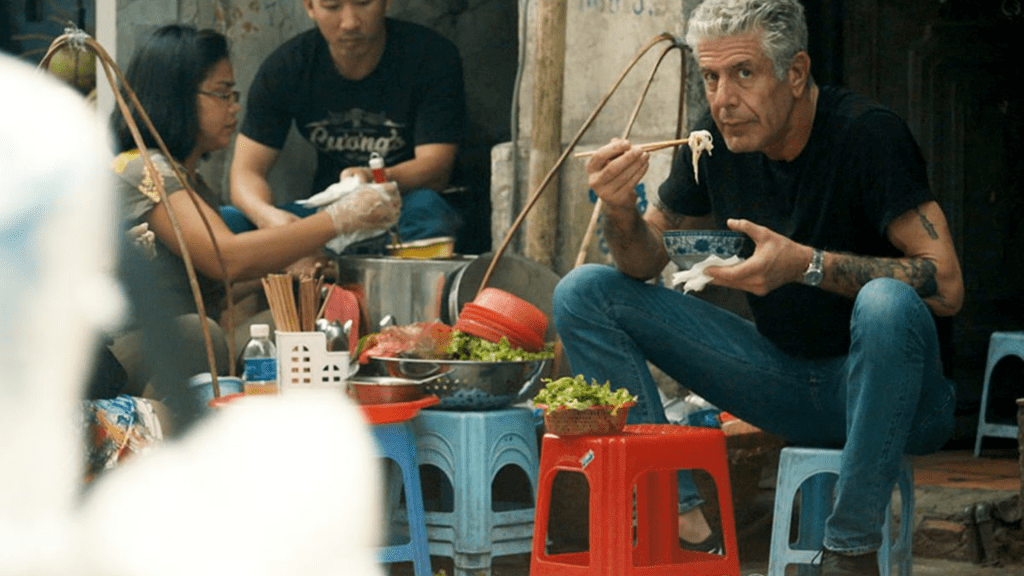
    I blame (and thank) Anthony Bourdain for keeping this love alive during my early adulthood. I devoured his shows like I devour a good banh mi. I’m talking reruns, quotes, emotional breakdowns—the whole fan club kit. I still remember the pure serotonin hit watching lanky Tony awkwardly perch on a bright red stool in Vietnam, slurping a local soup handed to him by a woman with a bubbling pot and zero time for nonsense. I felt that moment. His commitment to eating everything, everywhere, all the time? Iconic. Relatable. Deeply validating.

    I, too, would sit curbside in the most chaotic of places just for a bite of samosa chaat in Bombay, or noodles in Singapore, or fried things on sticks in Thailand that I can’t even name but will dream about for years. Tony got it. Tony was us.

    But now, back in Australia – the land of brunch and politely portioned tacos – I find myself dreaming of a different foodscape. Sure, we have “street food festivals” and “hawker-style events,” but if I need to sell a kidney to buy a $20 bao bun, we’re not really talking street food anymore, are we?

    I’m craving the real deal. The grit. The flavour. The auntie yelling “next!” without looking up. The faint hum of Bollywood music in the distance. The unapologetically spicy chutney that makes your eyes water but you go back for more anyway. THAT is the street food dream.

    So here’s to hoping that one day, we embrace a little more of that glorious chaos. Not a neatly plated, avocado-smeared version – but the real stuff. The soul food. The kind that doesn’t need a PR campaign because it’s too busy making you fall in love with life again.

    Until then, I’ll keep watching Bourdain reruns, dreaming of Juhu Beach, and maybe – just maybe – trying to recreate that coconut-carving technique in my suburban backyard (results pending, finger count may vary).

    Thanks for everything, Tony. And to street food – my forever love story.

  • Khichdi: The alchemy of comfort

    Ah, khichdi. The golden, mushy marvel that deserves its own place in the pantheon of life’s great comforts. Not just a dish – it’s a state of being. A molten lava-like concoction of spiced rice and lentils that quietly heals and revolutionises your soul, one spoonful at a time.

    How does one exist without khichdi? Seriously, I’d like to know. Because for as long as I can remember, khichdi has been the backbone of my survival strategy. Breakup? Khichdi. Thunderstorms? Khichdi. Wallet thinner than my patience on a Monday? Khichdi. Open fridge, echoing with emptiness? Khichdi to the rescue.

    This humble, unassuming dish is the mothership we all return to when life’s chaos threatens to send us hurtling into the void. Joyful moments, too – though let’s face it, khichdi thrives in crisis situations. Like a wise maternal figure with a ladle in hand, it soothes, nurtures, and slowly nudges you back to hope, humanity, and the quiet conviction that everything will, somehow, be okay.

    And let’s talk economics here. A bowl of khichdi costs mere pennies to make, yet its worth? Absolutely priceless. It’s kitchen alchemy at its finest—turning pantry staples into a meal that feels like it was sent from the heavens. Rice, lentils, maybe a pinch of spice, and voilà! Breakfast, lunch, or dinner is sorted. Khichdi doesn’t discriminate – it’s there for you, 24/7.

    So, next time you’re teetering on the edge of existential despair (or just staring at an empty fridge), let khichdi be your guide. It’s not just food – it’s sustenance for the body, balm for the soul, and proof that sometimes, the simplest things in life are the most profound.

    Alchemy? Maybe not. Khichdi is the philosopher’s stone.